Ho-sook
Awakening the Angel System: Apocalypse: A LitRPG Progression FantasyHo-sook is a nomadic teenager whose presence turns the royal household’s carefully managed order into something unruly, personal, and difficult to contain. Known to Jack as a constant troublemaker, she is first presented through a jail mugshot, yet her later actions show that she is not merely comic disruption: when armed attackers invade the palace and expose Celeste, Ho-sook places herself between the child and the threat with a kunai. Her arc therefore moves from troublesome outsider to constrained ward and, finally, to a courageous defender within the household’s most dangerous crisis.
Identity and Introduction
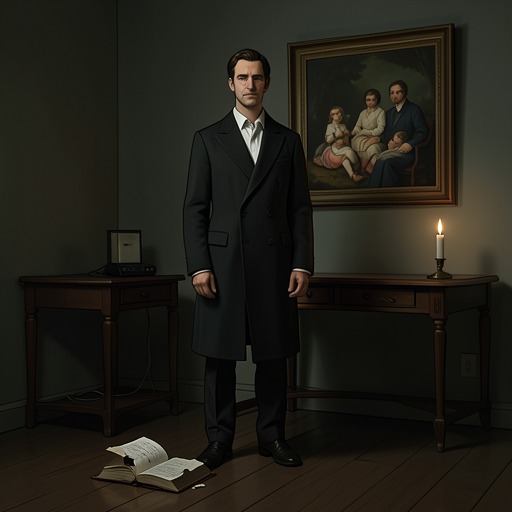
Ho-sook enters the story as the girl in a folder titled “Nomad.” Jack recognizes her immediately from a mugshot: she is a Korean nomad with a mischievous expression, sticking out her tongue at the camera. The image makes her identity a bureaucratic record before it becomes a personal encounter. Jack is so surprised that he considers going to the jail to confront her, establishing both her reputation for causing trouble and the unusual degree of attention she commands from him.
Her introduction is framed by systems of documentation and custody. The folder is part of a paper-based security practice rather than an Intellipad file, because sensitive schedules and identities could be hacked or exposed electronically. Ho-sook is consequently encountered as both a person and a security concern: her image is filed, her arrest is known, and her movements are treated as matters requiring official control. The contrast between the playful mugshot and the seriousness of the file gives her an immediately unstable position between adolescent mischief and political liability.
Life Under Royal Surveillance
Two weeks after Jack’s marriage to Selfia and coronation as king, the new monarch himself is confined to a luxurious room, permitted only limited visitors such as Kamila, Ada, Leona, and Celeste. Ho-sook belongs to the same wider atmosphere of managed movement, although her restriction is more explicit: she is placed under house arrest while Hoshido arranges for someone to collect her. The royal residence thus functions as a domestic space governed by confinement, schedules, and controlled access rather than freedom.
Ho-sook responds to that restriction with the same irrepressible refusal suggested by her mugshot. While Jack and the others are preparing to leave, she calls down from a balcony that she wants to come. Jack orders her back to her room and reminds her that she knows her job and will be punished if she causes trouble. She protests, ducks out of sight, and eventually complies only after a groan and the audible closing of a door. The scene makes her disobedience comic on the surface, but it also shows how quickly the household converts a teenager’s presence into a disciplinary problem.
The surrounding world is similarly organized through surveillance and controlled information. Jack travels with a security team in a heavily armored limousine, receives a detailed schedule of public appearances, and carries records concerning the people around him. The royal household’s authority therefore operates through paperwork, guards, restricted rooms, and repeated reminders of expected behavior. Ho-sook’s balcony outburst punctures that apparatus: she is visible precisely when she is supposed to remain contained, and her voice briefly overrules the silent discipline of the residence.
From Trouble to Protection
Ho-sook’s role changes decisively during the attack on the royal household. While Ada searches for a way to respond, Kamila lies injured beneath a crater in the wall, and Celeste hides under a bed. Ho-sook is present with the child, and when the Purple Pawn flips the bed over and exposes Celeste, Ho-sook immediately jumps in front of the smaller girl with a kunai in hand.
That gesture gives practical meaning to the earlier references to Ho-sook as a troublesome child. Her defiance is not simply indiscriminate disruption; in the crisis, the same refusal to remain passive becomes protective action. She does not wait for permission, retreat, or the arrival of an adult defender. She interposes her own body and weapon between Celeste and an armed attacker, turning an apparently unserious adolescent into the first visible barrier protecting the child.
The scene also establishes a contrast between institutional power and improvised courage. The attackers include black-clad soldiers and the Purple Pawn, while the palace’s defenses have already been breached and Kamila has been wounded. Ho-sook’s kunai is therefore not presented as an equal response to the invasion’s military force. Its significance lies in the decision to stand forward despite that imbalance. Her action preserves the household’s familial bonds at the moment when armor, rank, and palace security have failed.
Relationships and Narrative Function
Ho-sook’s relationship with Jack combines familiarity, authority, and exasperation. Jack knows her well enough to identify her instantly from a photograph and reacts as though her arrest is a personal problem rather than a distant administrative fact. At the same time, once she is placed under house arrest, he speaks to her as a guardian enforcing rules, ordering her back to her room and warning her about punishment. Their exchanges position Jack between parental concern and royal discipline.
Her connection to Celeste is expressed less through explanation than through action. Ho-sook is present while Celeste hides, and she responds to the child’s exposure by taking the forward position herself. The protective gesture is especially striking because Ho-sook is also a confined minor whose own status is precarious. She is not safeguarding Celeste from a position of official power; she protects her as another young person caught inside a system controlled by adults, soldiers, and political arrangements.
Ho-sook also operates as a counterpoint to the royal household’s polished public image. Jack’s day is organized around academies, museums, investors, local businesses, security procedures, and the public announcement of an heir. Ho-sook remains the unmanageable figure at the edge of that ceremonial program: a detained nomad, a teenager who calls from a balcony, and a girl whose presence cannot be reduced to the role assigned to her. Her disruptive energy exposes the tension between the monarchy’s public performance and the vulnerable people inside its walls.
Change and Narrative Significance
The available episodes do not provide a complete account of Ho-sook’s later fate, but they establish a clear movement in how the narrative presents her. She begins as an arrested troublemaker recorded in a mugshot, continues as a teenager placed under house arrest and repeatedly reminded to obey, and reaches her strongest characterization when she defends Celeste during a lethal intrusion. The progression does not erase her mischievousness; it reinterprets it by showing that her refusal to submit can also become loyalty and courage.
Ho-sook’s importance lies in this reversal. The institutions around her classify, confine, schedule, and monitor bodies, yet they cannot fully determine what those bodies will do under pressure. Her movement from balcony protest to armed protection embodies the book’s recurring concern with the gap between official identity and lived action. The file calls her a nomad and an arrested delinquent; the crisis reveals someone willing to stand between a child and overwhelming violence. In that contrast, Ho-sook becomes more than comic relief or a political problem: she is evidence that the household’s least controllable figure may also be one of its most instinctively protective.